About Seeing
“…fact and the classification of fact, are inextricably mingled, in such a way that no such reading is undertaken in extrinsic isolation”. – Catherine Picstock, Aspects of Truth: A New Religious Metaphysics.
There is something restless about the creative gap between the aestheticism of the senses and the contexts used to give an occasion a retrievable identify. Looking for the “one” aspect in a work to associate with, takes the senses away from their root of direct engagement. The weak and strong cultural inference is derived by first-person, authentic perception, except that perception rests on a curated collection of experiences. Those curated experiences can be indirectly shared by the language of association. But the associating language obscures what wants to be expressed through the physical memory of the senses. Physical senses and their associative concepts, collapse into a resonating gestalt.
At best, the object in the foreground of a painting becomes a product of its native environs. The interplay between foreground and background is generative and inextricably conjured by physical sensation that holds together a spiral of interlinking mental concepts, so that nothing in the overall macro image can be seen as a micro detail in extrinsic isolation.
The early appraisal of what details are “relevant” to a painting’s overall, classifying statement, grows as a more comprehensive story fills out with the dimensions of more noticeable details. Eventually, the idea about the painting transcends the images chosen for illustration. A painter can only give identity to objects through collectively understood associations. That does not mean to say that the viewer is some being with a universe of cultural understanding to call on.
The artist has to second guess his audience in terms of what is likely to land. Beyond their ready-to-hand utility, objects also hold cultural significance. A species of flora or fauna brings their own symbolic associations. An encyclopedia of symbols are of lesser use than the aesthetic associations give to a sunflower or a fox. Both bring a defining context which is not predetermined, but can bring determination to reading, depending on their greater context.
This becomes even more intense when the dialogue is between still-life objects and a very alive landscape. The theme of Memento Mori and Nature Morte has occupied much of my recent work. I have developed the intersection between things remembered and natural life cycles of death and rebirth. Often, something has to be reborn, or re-presented into memory. Nothing seems to fall into the vacuum of a totally blank canvas. Just as nature abhors a vacuum, the imagination wants to pull on an endless array of symbols to apply to each mark that is being made.
My recent interest has included the work of one of New Zealand’s greatest artists. Frances Hodgkins: 1869–1947, had an independent eye that married still-life objects with dynamic landscapes collected in from supportive friends. Although her early passion was for watercolours of colonial women found in her South Island home town of Dunedin, her subject matter grew when she started studying in England and on the European continent. Resisting the pull of the hyper individualistic ideology of the Bloomsbury Set, or the cult around Augustus John, she found an alternative muse that set her on an innovative path of her own making. Without the fashionable trappings of London and Paris, she could steal approaches from the various genres, which would include experiments with cubism and the early modernists that would include Les Nabis. What she introduced to this mix is the importance of the greater landscape as a storied backdrop to the wide variety of objects that constituted a still-life foreground.
Holding tension between foreground objects, while using background as a unifying setting, makes demands on the artist to keep enough unintentional space for something unexpectedly playful to arrive. This dialogue between foreground and background opens up an opportunity to introduce a more interesting story than first anticipated. Any object depicted can be repurposed to fulfill a new conceptual role when the landscape behind is more fully described. The depiction is important, but so too is the juxtaposition of associative meaning.
A painting can convey a feeling and a narrative. Without the need for human figures being shown, the viewer can be introduced to a liminal space that is pregnant with possibilities. The eye needs places to stop and rest as well as initiating edges that keeps it rotating, looking for further clues about subject matter. A quieter passage in the background can pull its viewer past old assumptions, and anneal anomalies into a higher resolution of meaning. If a painting can resolve gaps of understanding between causes and effects, it bridges disparate ideas and expectations that leaves the viewer in an unexpected place of further awareness.
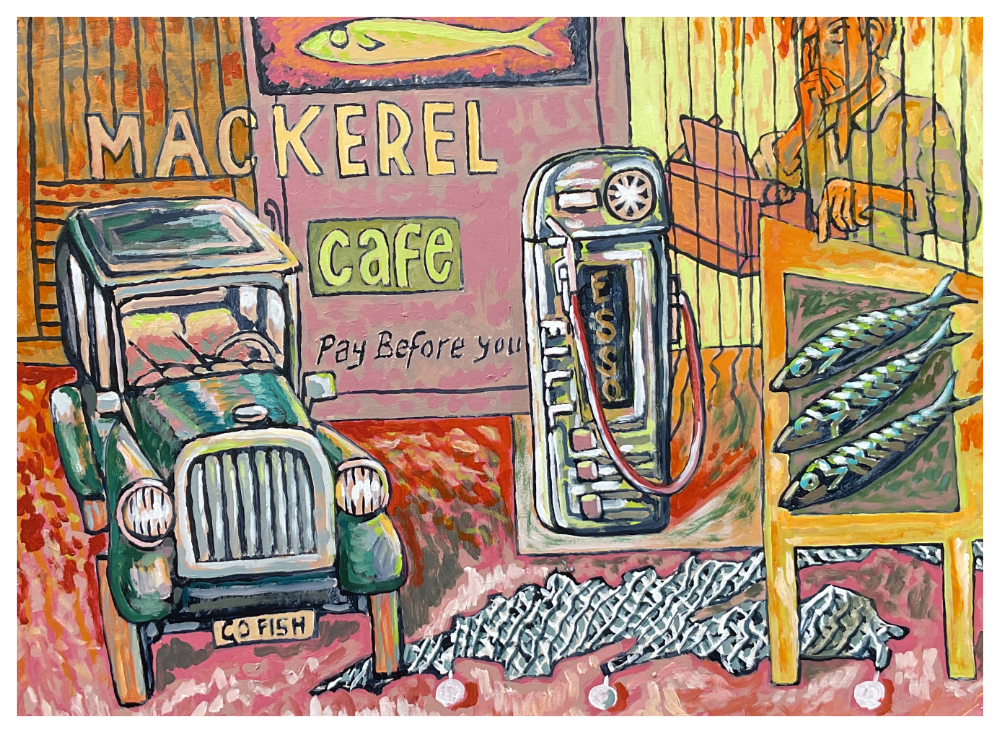
As an example, the painting bellow is titled “California Spawning – A Fishy Story”. It calls on an earlier time to be revised as a Second Naiveté. The first naivete being a more simple set of expectations. Along with time spent on fruit orchards and canning factories, the explorative automobile was king, made possible by Ford and abundant gasoline. Californian coast opened up to new jobs and adventure. The Mackerel Cafe is presented here as a bait shop, which trusted you with self-serve gas station. Perhaps the writer in the background is more contemporary; remembering his dad’s stories about fishing and uncrowded beaches. Perhaps its a particularly “fishy story” because the retelling of the old days need always needs to be tempered by the poverty of the depression, as featured in Hemingway’s “To Have, and Have Not”.
A title serves in two ways, it offers a greater context than the one depicted, and directs the viewer to scavenge clues that might shed more light on the title. Symbols hide as well as disclose. In the example given, what the journalist or poet is writing on his typewriter is undisclosed. No object can be fully taken at face value. There is an inviolable space around them that yields only the most vicarious reading. The creative act is a matter of peeling away several layers before a central connection can be found. The most centering aesthetic is often the one lurking beneath. In this case, the relic of a crumpled fishing net at the base of the picture is a clue to the story.